VeloBenchmark is a self-contained benchmarking console for any OpenAI-compatible endpoint. Live decode instruments on every stream, repeatable test suites, concurrent load with a step barrier, exportable reports — and an OTLP receiver that turns your engine's own telemetry into the same numbers.
Every number is computed server-side from real streaming token timing and snapped
to the provider's authoritative usage counts when reported. The UI is
a window onto the same data the reports store.
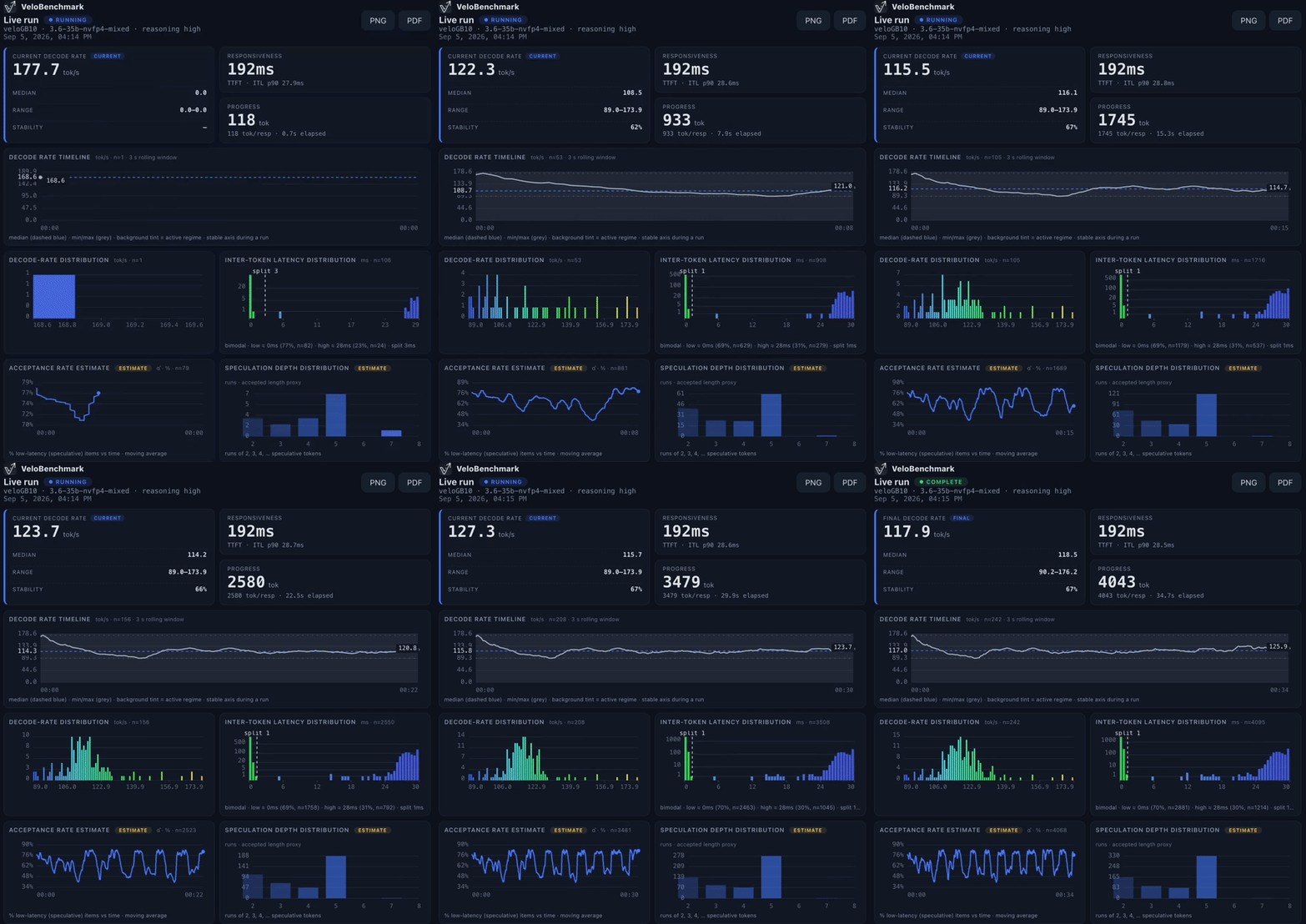
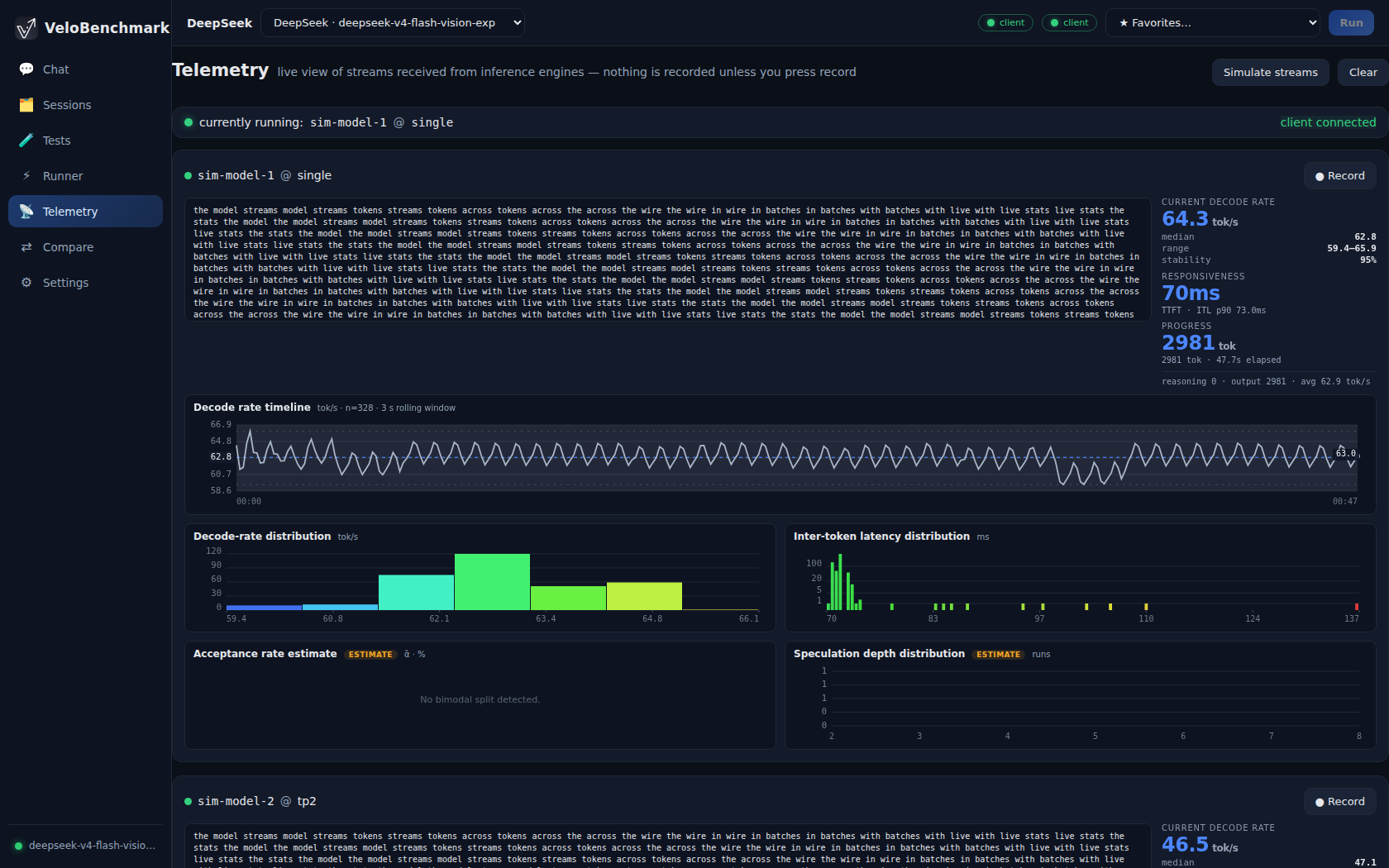
Rolling decode tok/s, TTFT, inter-token latency, min/median/max and stability — streamed per token while the answer generates, with PNG/PDF export of the panel.
Output is tagged as prose, code, math, JSON or reasoning as it streams. Charts split by regime, so a model slowing down on math and speeding up on code is visible inside a single answer.
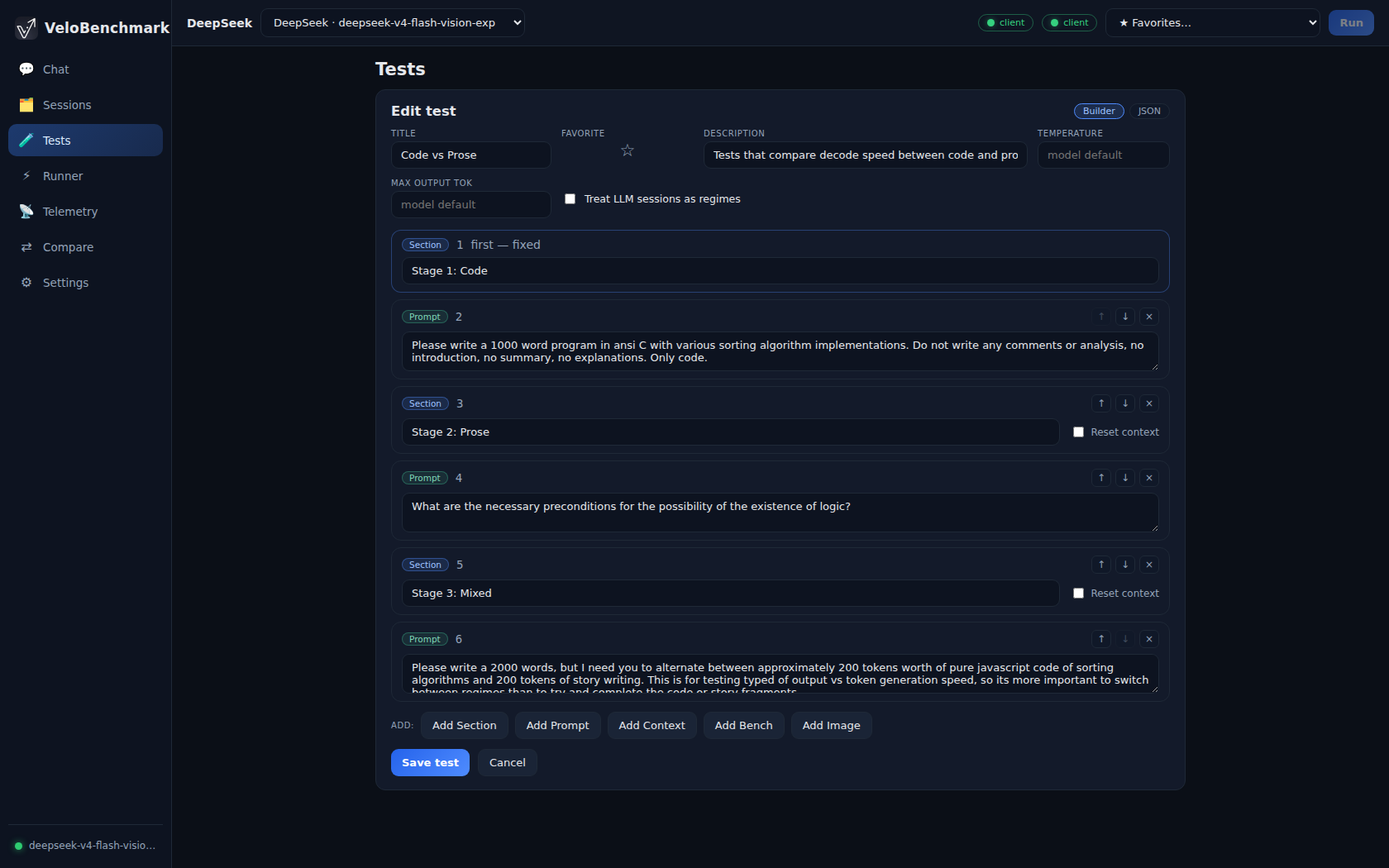
A visual builder with five step types — sections, prompts, exact context fills, fixed-shape bench requests and vision steps — plus built-in reference suites and a JSON editor.
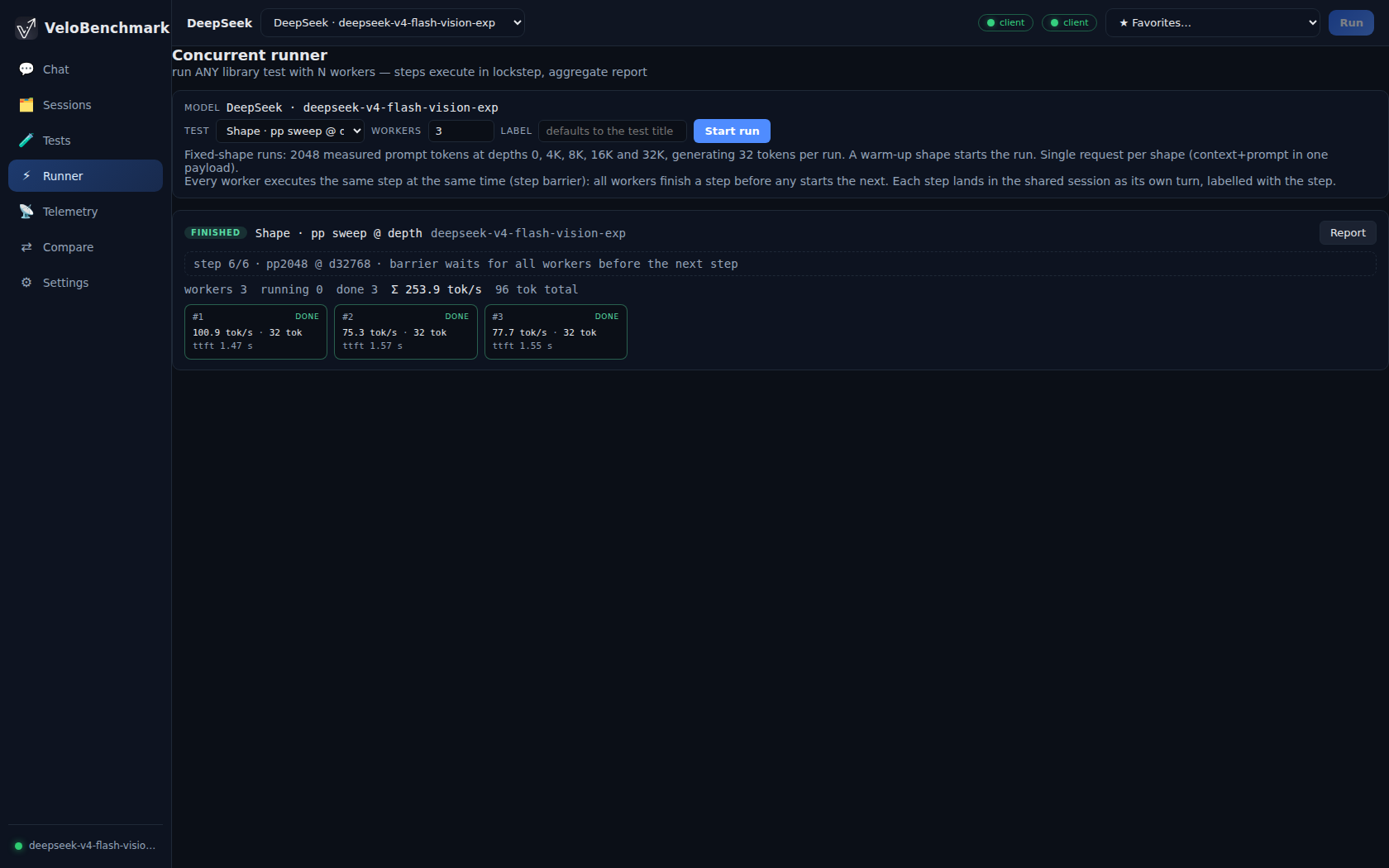
N workers walk the same test behind a step barrier. Per-worker snapshots live, and the report gains a workers + Σ decode timeline: your effective concurrency throughput.
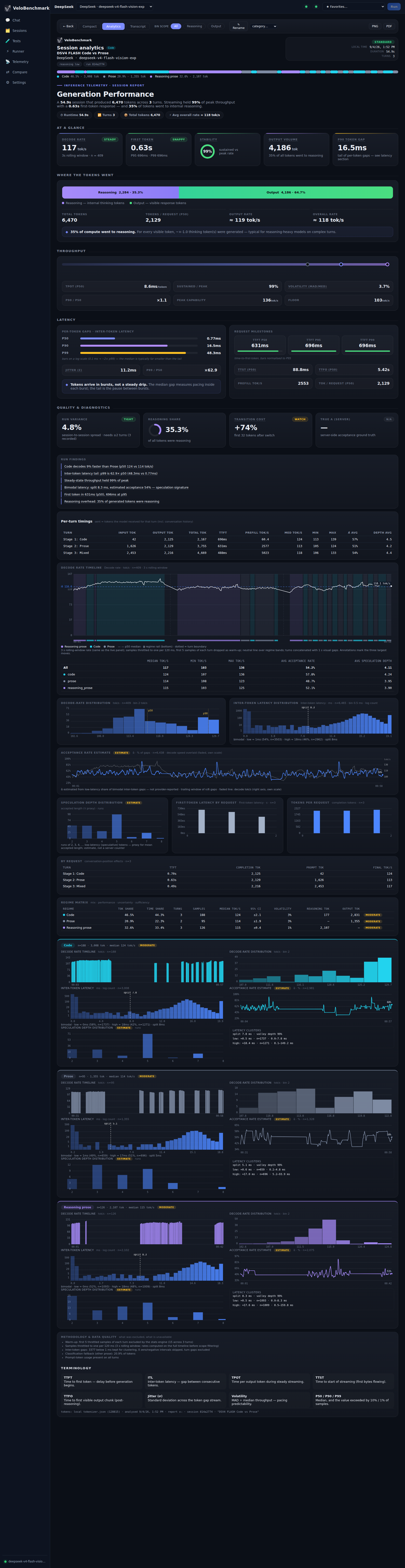
Per-session analytics — throughput, latency distributions, token composition, speculation diagnostics — and persistent side-by-side comparisons of any sessions, exportable to PNG/PDF.
A built-in OTLP/HTTP-JSON receiver turns a serving engine's OpenTelemetry stream into live per-stream panels — and one click records a rolling window into a permanent session report.
VeloBenchmark speaks the ecosystem's language: the same definitions as vLLM, AIPerf and Artificial Analysis, computed from the stream alone where possible and labelled estimate where they are inferred. Speculative-decoding behaviour surfaces as an acceptance-rate estimate and a speculation-depth distribution — from bimodal inter-token latency, without server counters.
The benchmarking and live-stats console. Chat with live instruments, build test suites, scale them to concurrency, compare sessions, and front your serving engine's OpenTelemetry stream with the built-in OTLP receiver. One binary; the whole UI embedded; settings and sessions stored server-side.
A from-scratch Rust + CUDA inference engine for NVIDIA GB10 systems (DGX Spark & compatible): NVFP4 tensor-core serving, bitwise-lossless MTP speculation, and tensor parallelism across two or four boxes as a speed mode — up to ~125 tok/s sustained on Qwen3.8-27B.
VeloBenchmark and veloGB10 are free forever under AGPL-3.0 and Apache-2.0. When you need it integrated into your pipeline, extended for your workload, or tuned on your hardware, that work is available under contract — scoped, quoted, and delivered with acceptance criteria.